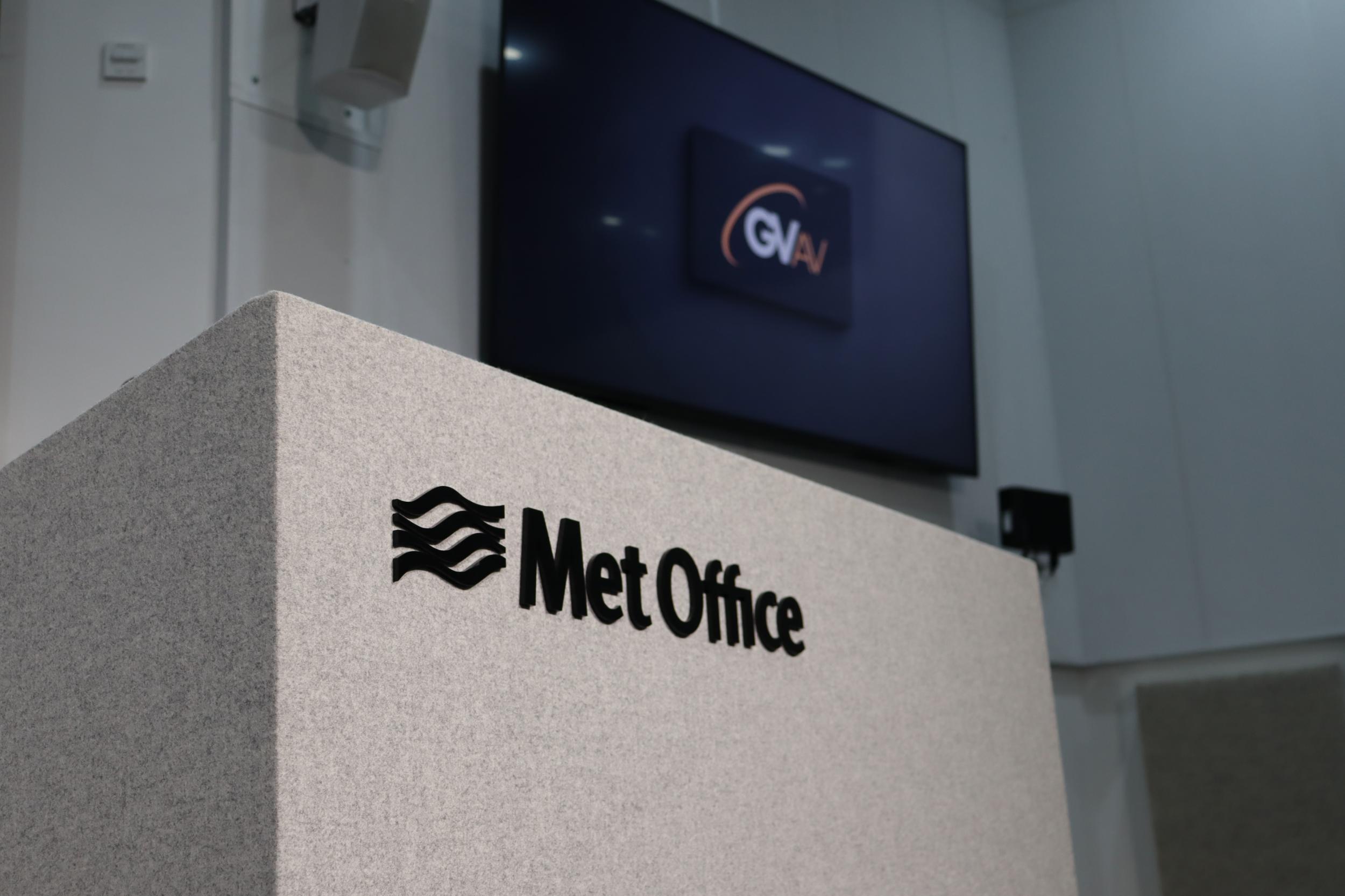
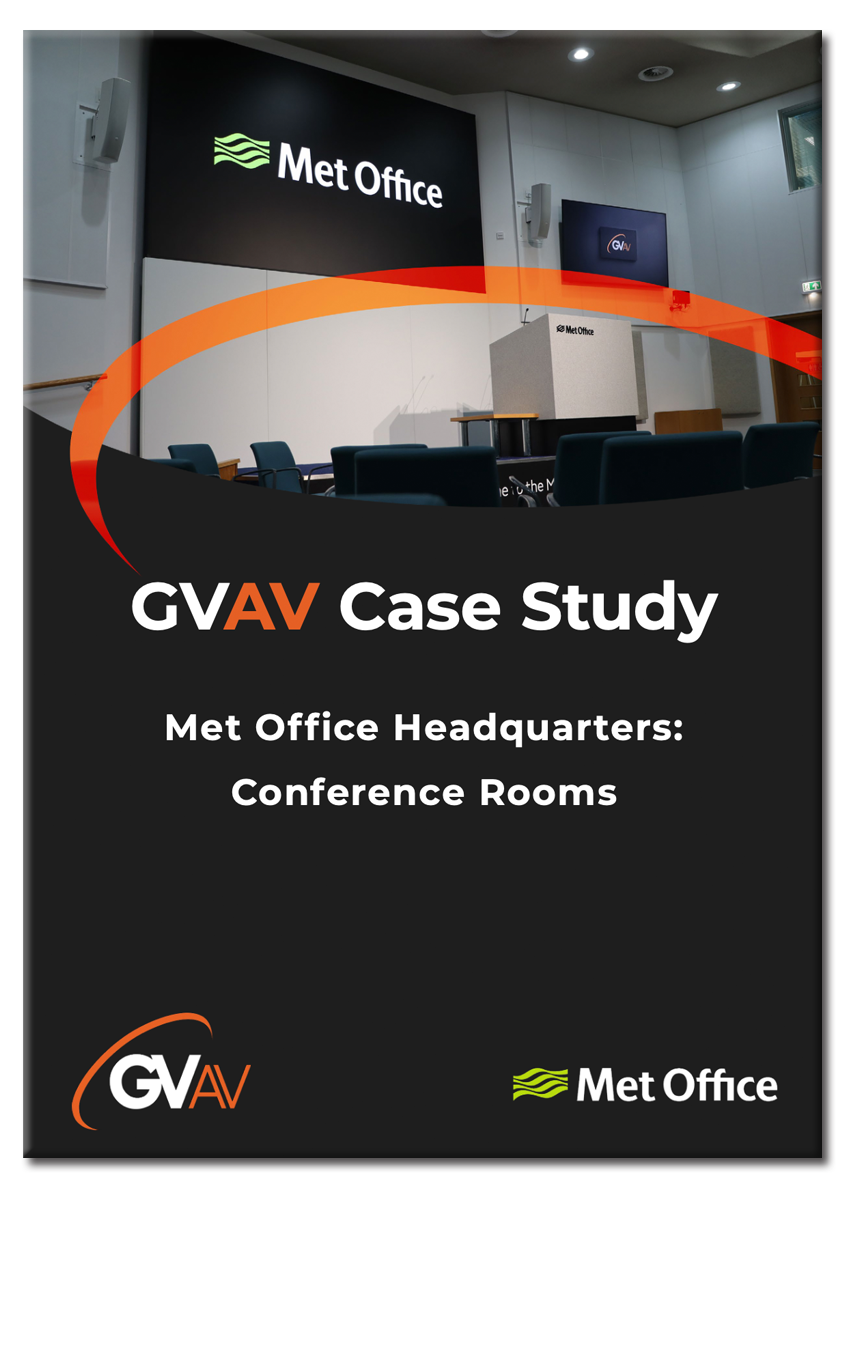
Met Office HQ Conference Rooms

AV INSTALLED

Absen LED walls

Novastar processing

Sony displays

iiyama monitors

Visionary AVoIP

Netgear switches

Poly MTRs

Q-SYS DSP & control

Shure mics

​​​​​​​Audio visual case study​​​​​​​​​​​​​​

As the UK's national meteorological service, the Met Office provides weather forecasting and climate science to the general public, as well as to crucial sectors like the emergency services, aviation and defence. Its headquarters in Exeter has served as the organisation’s global operational and scientific hub since moving there in 2003.

​​​​​​​

The organisation identified a requirement to upgrade their two main conferencing rooms to better accommodate in-person and hybrid meetings. GVAV were appointed to design, supply and install the upgraded audiovisual system for these key rooms, centring on four priorities: large-format, high-quality visual displays; fully integrated hybrid conferencing capability; professional audio coverage; and intuitive room control. At the heart of the design was a focus on combining high-performance AV with a considered, sustainable approach, ensuring long-term reliability while reducing operational impact.

To do

The refreshed conference rooms would require a robust, reliable new AV system, while the rooms’ displays needed to be clear and vibrant for everyone within the space, performing well under bright ceiling lighting.

To achieve this, direct-view Absen KLCOB LED walls were specified for each space. With 1.5mm pixel pitch, KLCOB uses chip-on-board (COB) technology, bonding LED chips directly to the circuit board rather than using surface-mount packaging.

The result is a cinema-grade colour gamut and sustained brightness between 600 and 1,000nits. A black polymer surface coating reduces glare and adds depth to dark image content, making the display highly effective in a large, bright room.

In the unlikely event of a section failing, individual modular LED panels can be replaced without disrupting the rest of the wall. This also means that the display can be maintained entirely from the front, so there’s no need for rear access, reducing maintenance time and disruption.

Each LED display is driven by a dedicated Novastar video processor handling real-time scaling and layout management. Both rooms are also equipped with a Sony 85" 4K display as a secondary screen, displaying additional presentation content as required. As well as image performance, these displays were selected for their strong sustainability credentials, including energy efficiency and reduced-impact packaging.

Source routing and video distribution across both rooms is handled by Visionary's AV over IP platform. Rather than running fixed point-to-point cabling between every source and display, the system encodes video, audio, USB, and control signals as data and distributes them across a managed network. Visionary AVoIP was selected for its low-power, fanless design, AES67 audio integration, video preview capability, as well as strong technical support and warranty.

The network supporting the system runs across two Netgear M4250 managed switches, providing the bandwidth, IGMP multicast support, and PoE infrastructure needed to handle multiple simultaneous 4K streams reliably. All connected devices across the network are monitored and reported through the wider control ecosystem, allowing proactive fault identification and streamlined system management.

To do

Aligning with the Met Office’s existing estate for a consistent user experience and centralised management via the Poly Lens admin portal, each conference room runs a Poly G62 Microsoft Teams Rooms system.

This includes an E60 PTZ camera with 12x optical zoom and automatic speaker tracking, adjusting framing without additional manual input. Meetings are managed from touch controller accessible from each lectern. The conferencing system is integrated directly with QSC audio infrastructure via a I/O USB Bridge, while audio processing is managed by a Q-SYS Core24F DSP, with outputs fed through Crown power amplifiers before reaching new Sonance ceiling speakers and the rooms’ existing JBL speakers mounted either side of the main display.

The Q-SYS platform was selected for its ability to unify control and monitoring across all system elements, while also enabling video-preview-based switching, system reporting and remote support via the Q-SYS Reflect portal.

Each room has a selection of wireless Shure Axient Digital wireless microphones, housed on a docking station. Shure gooseneck mics are integrated within the lecterns for fixed position presentations. The cutting-edge 24-channel receiver also allows for future expansion through licensing, enabling additional channels without requiring new hardware.

Both rooms are also equipped with a legacy Sennheiser infrared assistive listening system for those with hearing difficulty. The system was an existing installation that had fallen out of use, and was recommissioned and tested by GVAV beyond the original project scope. Unlike induction loop systems, the IR signal is contained within the room and cannot pass through walls, making this a secure solution for sensitive meetings.

Integrated within each lectern is a dedicated iiyama confidence monitor providing a local view of the main LED wall display content. Meetings can be joined with one touch from a familiar Microsoft Teams Rooms interface via a Poly 10” touchscreen display also on the lectern. Users can also bring their own device and plug directly into the system to share content to either display.

The system has been designed with ease of use as a top consideration, meaning any presenter or meeting organiser can walk into either room and be operational within seconds. Each room’s lectern has a third display integrated - a Q-SYS touchscreen with a GVAV-designed custom GUI, giving users clear and simple control over input source selection, audio and room lighting without any additional user training required. Integrated power management, including SurgeX protection, ensures that key systems such as the LED displays can be fully powered down when not in use, reducing unnecessary energy consumption.
On handover of the space, GVAV produced detailed user guides for the two spaces, including full operating instructions and technical guidance.

With these refreshed conference rooms now in use, the Met Office has two modern spaces designed for more engaging and productive hybrid conference events. Through the Absen LED wall, clear and bright visuals are delivered into the room, while meetings run on the familiar Teams platform that staff already know, with professional-grade audio and a camera system benefitting those joining a call from a remote location. The design also supports long-term sustainability, with energy-efficient technologies, system monitoring, and future expansion built into the solution.

Working alongside the Met Office’s in-house technical team, both spaces have been upgraded to perform reliably over the long term, and to keep pace with the people who use them.

"From the initial design phase through to final delivery and post-installation support, working with GVAV has been a genuinely positive experience. Their technical expertise and ability to translate complex requirements into a practical, high-quality solution has been evident throughout the project.

The team demonstrated strong project management and a clear passion for delivering the best possible outcome. In particular, Lee Reynolds and Dan Victory stood out for their professionalism and engagement. Dan consistently went above and beyond expectations, offering thoughtful solutions, helping to remove blockers, and providing a balanced, pragmatic perspective that helped drive the project forward.

GVAV have not only responded to our technical queries with clarity and depth, but have also remained committed during installation and beyond, dedicating time to resolve snagging issues and ensure the solution operates as intended. Their willingness to support, refine, and improve the final outcome has been highly valued.

Overall, this has been a well-managed and collaborative engagement, resulting in a solution that meets our needs and has been a pleasure to deliver alongside them"

Aaron Smith

Lead Technical Architect, Met Office

Met Office HQ